

Text K Wallace and G Giles
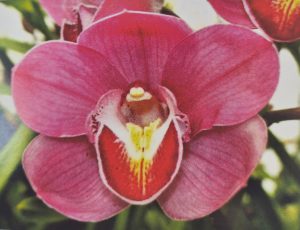
We are writing this article to apologise to all those who bought a clone of Lunar Blaze ‘Dural’. A lot of us have experienced the problem of bud-drop this year; we will try to explain why and hopefully give some suggestions.
Before we cloned this plant, we did it in 2007, we trialled it for a number of years. We do this with any plant that we clone as we want everyone, including ourselves, to be happy with the result. The plant was trialled for four years from first flowering. It seemed to be something special, indeed we even considered never releasing it as it appeared as if it would be an excellent plant. It is very free-flowering, the growth is compact and the leaves not too large. The spike habit is upright and strong, indeed hardly needs a stake; the flower shape and colour are excellent. It seemed almost too good to be true so what went wrong. It is our opinion the blame can be laid at the door of climate change.
To support this claim I would like to relate my early experience in the horticultural industry as a commercial flower grower, this is before Gordon and I started in our current business, about 40 years ago in Dural, in the early to mid 1970s. Frost was always a threat to our carnation crops because we could lose an entire crop if we had a severe one, and we had to be on the look-out from as early as Anzac Day in April. If we did have a frost we would have to activate our sprinklers before the sun rose to wash it off. Look at this year, we are already in towards the end of June and have hardly had any wintry conditions, let alone a frost.
We must state here we can only talk about the Sydney basin. If any of the following apply to the reader’s area, you will have to decide if you are influenced in the same way. Now many growers will remember that the 2013 flowering season wasn’t what it could have been. We believe that this was virtually entirely due to the lack of cool nights in October, November and December 2012. The same period in 2013 was somewhat cooler, hence a better flowering in 2014. This year, at least in our nursery, the plants are coming into flower at 4 to 6 weeks earlier than normal.
For some years now the flowering season has been edging earlier. For those few of us left that remember when the NSW Orchid Society held their spring show in Sydney Town Hall, they will recall it was held well into September. The first show of the season was held by the Ku Ring Gai Orchid Society at Killara towards the end of August. The biggest problem was to have plants out in flower and it was often said it was too early to stage a decent show.
Compare that with today; now improved culture has helped and has probably brought the flowering forward by maybe a week or so, certainly not four to six weeks. As further proof that the climate is changing, this year in the Dural area we have had the Queensland Wattle fully out in flower by the third week of May, when wattles usually flower in August, with Wattle Day being the first of August. Swanes, one of our local nurseries, have their rose plants in full flush the first week of June, in our nursery we have a bougainvillea in full bloom, and we have seen others locally in the same condition.
So can we do anything to stop the flowers opening early — the short answer is NO, to try to improve spiking maybe. Unfortunately Lunar Blaze ‘Dural’ is one that does not cope with the warmer conditions, causing it to abort its buds. In our experience some crosses using LBD have also suffered the same fate. We would appreciate any feedback from growers in Tasmania if they are experiencing any such problems.
To improve spiking we water our plants at night in the months of October, November, December. We split the watering by setting the time clock to water at 1am and 5am for 2 minutes approximately. We feel that as the water evaporates it has a cooling effect on the plants thus chilling them below 16° as is needed. We are told that the water temperature is not low enough, which is correct, however don’t you think that if you were to have your clothes soaked at night you would feel cold as the water evaporates.
This procedure can not hurt and indeed it is an excellent way of keeping two spotted mite at bay. We are also experimenting with a change to our fertiliser.

 Keith Wallace Nursery